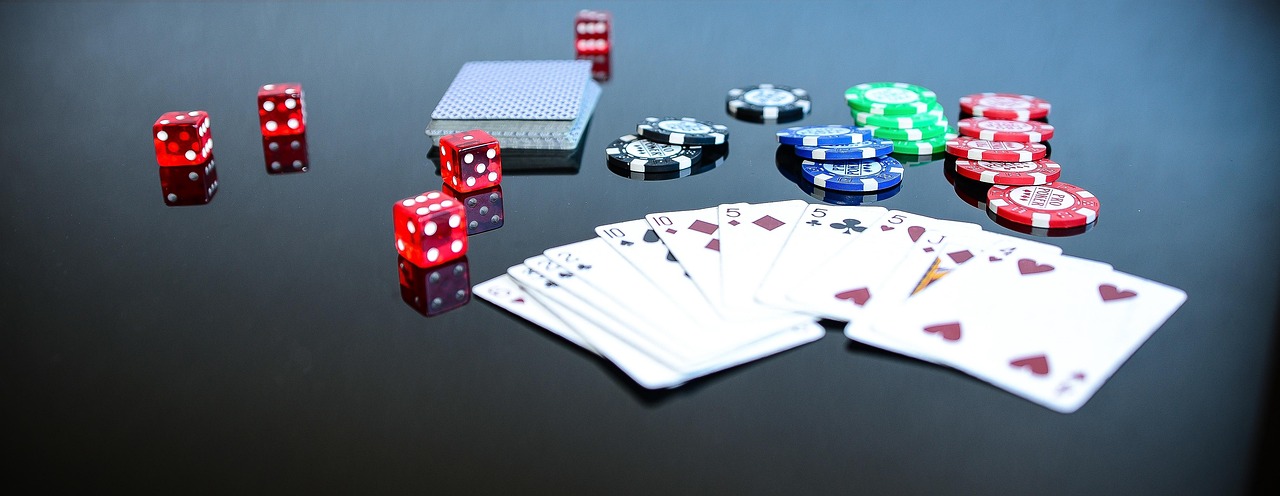
The pass line resolves to exactly 7/495. The odds bet behind it pays true and carries no edge at all. Here is where both numbers come from, bet by bet.
I. Everything starts with 36 outcomes
Two six-sided dice produce 36 equally likely ordered outcomes. Every number in craps — every payout, every edge, every superstition on the rail — is a statement about how those 36 outcomes partition. There is no deck composition to track, no dealer decision to anticipate, no shoe to penetrate. The sample space is fixed and fully known before the first throw, which is what makes craps the cleanest derivation in the house.
| Total | 2 | 3 | 4 | 5 | 6 | 7 | 8 | 9 | 10 | 11 | 12 |
|---|---|---|---|---|---|---|---|---|---|---|---|
| Ways | 1 | 2 | 3 | 4 | 5 | 6 | 5 | 4 | 3 | 2 | 1 |
The seven is the most frequent total at 6 ways in 36, and that single fact drives the entire game. It is the come-out winner and the point-phase killer — the same number switching sides depending on which phase you are in.
II. The come-out roll
A pass line bet is made before the come-out. Three things can happen:
win on 7 or 11 = 6/36 + 2/36 = 8/36
lose on 2, 3 or 12 = 1/36 + 2/36 + 1/36 = 4/36
establish a point on 4, 5, 6, 8, 9 or 10 = 24/36
Note the asymmetry: the come-out favours the pass bettor two to one. If the game ended here it would be a wildly positive bet. It does not end here — two thirds of come-outs establish a point, and the point phase is where the edge lives.III. Making a point
Once a point is set, only two totals matter: the point itself and the seven. Every other roll is irrelevant. So the probability of making the point is simply its ways divided by its ways plus the six ways to roll a seven — a clean conditional probability with no memory and no sequence to it.
P(make point) = ways(point) ÷ [ways(point) + 6]
| Point | Ways | P(make it) | True odds against | Free odds pay |
|---|---|---|---|---|
| 4 or 10 | 3 | 3/9 = 1/3 ≈ 33.3% | 2 to 1 | 2 to 1 |
| 5 or 9 | 4 | 4/10 = 2/5 = 40.0% | 3 to 2 | 3 to 2 |
| 6 or 8 | 5 | 5/11 ≈ 45.5% | 6 to 5 | 6 to 5 |
Premise. Fair dice, each of the 36 ordered outcomes equally likely, standard casino rules with a required back-wall bounce. The final two columns of this table are identical — that identity is the whole subject of section V.
IV. The pass line, resolved to a single fraction
Combine the come-out with the point phase. The pass line wins immediately 8 times in 36, or later by making whichever point was established:
P(win) = 8/36 + 2 × [(3/36)(1/3) + (4/36)(2/5) + (5/36)(5/11)]
= 244/495 ≈ 0.49293
The factor of 2 pairs each point with its mirror — 4 with 10, 5 with 9, 6 with 8 — since each pair shares identical ways and identical probability.Because the pass line pays even money, the house edge is the gap between winning and losing probability:
edge = 1 − 2 × (244/495) = (495 − 488)/495 = 7/495 ≈ 1.4141%
Not an approximation, not a simulation result, not a figure that shifts with the number of decks or the dealer's discretion. Seven parts in 495, permanently.Don't pass — betting against the shooter — runs slightly cheaper because the 12 on the come-out is a push rather than a win for the dark side, which is precisely the mechanism that hands the house its margin on that bet:
edge = 27/1980 ≈ 1.364%, measured per bet made
V. Free odds — the only bet in the building priced at cost
After a point is established, you may place an additional wager behind the line. It pays the true odds from the table in section III, and that is the entire story. Take a point of 4: three ways to make it, six ways to seven out, so the true odds against are exactly 2 to 1 — and the bet pays exactly 2 to 1.
EV = (+2 × 1/3) + (−1 × 2/3) = 2/3 − 2/3 = 0
on the 5: (+1.5 × 2/5) + (−1 × 3/5) = 0.6 − 0.6 = 0
on the 6: (+1.2 × 5/11) + (−1 × 6/11) = 6/11 − 6/11 = 0
Zero on every point, exactly. The house takes nothing on this wager. It exists because the odds bet can only be made behind a line bet that does carry an edge — the free odds are the bait attached to the priced hook, not a gift.VI. What odds actually change — and what they don't
Here is the sentence that trips up almost everyone who reads a craps strategy page: "taking odds lowers the house edge to 0.37%." It is arithmetically true and conceptually backwards. Your pass line bet still carries its 1.41%. Nothing you place behind it alters that. What changes is what you divide the expected loss by.
average odds wagered per come-out = (6/36)(3) + (8/36)(4) + (10/36)(5) = 100/36 ≈ 2.778 units
total average staked = 1 + 2.778 = 3.778 units
edge per unit staked = (7/495) ÷ 3.778 ≈ 0.374%
Same expected loss in dollars. Larger denominator. The 0.374% figure is a statement about efficiency of exposure, not about paying the house less.- Your expected loss per come-out is unchanged by taking odds: it stays at 7/495 of the line bet.
- Odds put more money at genuine zero cost, so the blended percentage falls.
- That also means bigger swings. Zero edge is not zero variance — you are increasing the size of the ride, not removing risk.
- Never bring money to the table for odds that you would not otherwise be willing to lose. A zero-edge bet is still a bet.
VII. The rest of the layout, priced
The same 36-outcome derivation prices every other bet on the felt. The spread between the cheapest and the most expensive is roughly twelvefold, and the expensive ones are printed in the biggest type at the centre of the table:
| Bet | Pays | House edge | Premise |
|---|---|---|---|
| Pass line + 3-4-5x odds | even + true odds | ≈ 0.374% | Per unit staked across line and odds |
| Don't pass | even money | ≈ 1.364% | 12 pushes on the come-out |
| Pass line (no odds) | even money | 7/495 ≈ 1.414% | Exact closed form |
| Place 6 or 8 | 7 to 6 | 1/66 ≈ 1.515% | Bet in multiples of 6 |
| Place 5 or 9 | 7 to 5 | 4.000% | Bet in multiples of 5 |
| Buy 4 or 10 | 2 to 1 less 5% | ≈ 4.762% | Commission paid up front, win or lose |
| Field | 2:1 on the 2, 3:1 on the 12 | 1/36 ≈ 2.778% | Triple on the 12; 5.556% if both ends pay 2:1 |
| Place 4 or 10 | 9 to 5 | 6.667% | Bet in multiples of 5 |
| Big 6 / Big 8 | even money | 1/11 ≈ 9.091% | Strictly worse than placing the same number |
| Hard 6 / Hard 8 | 9 to 1 | 1/11 ≈ 9.091% | Loses to any 7 or easy way |
| Any craps / Yo (11) | 7 to 1 / 15 to 1 | 1/9 ≈ 11.111% | One-roll bet |
| Hard 4 / Hard 10 | 7 to 1 | 1/9 ≈ 11.111% | Loses to any 7 or easy way |
| 2 or 12 | 30 to 1 | 5/36 ≈ 13.889% | One-roll bet, single way to win |
| Any 7 | 4 to 1 | 1/6 ≈ 16.667% | The most expensive bet on the table |
Premise. Every figure above is an exact closed-form value derived from the 36-outcome sample space at the stated payout. Payouts vary between properties — a field that pays 2:1 on both ends instead of 3:1 on the 12 doubles that bet's edge, and a Buy commission charged only on wins rather than up front changes the 4.762% substantially. Read the felt, not the folklore. A fuller treatment of how rule variants move these numbers is in the rule-variant ledger.
- The 36-outcome ways table generates every craps number; nothing else is needed.
- The pass line is exactly 7/495 — about 1.41% — and does not move.
- Free odds pay exactly true odds, so their expected value is exactly zero on every point.
- Odds do not lower your cost; they enlarge the denominator. Same expected loss, more money exposed, wider swings.
- The proposition bets in the centre run 9% to 16.67% — roughly twelve times the line, on the same table.